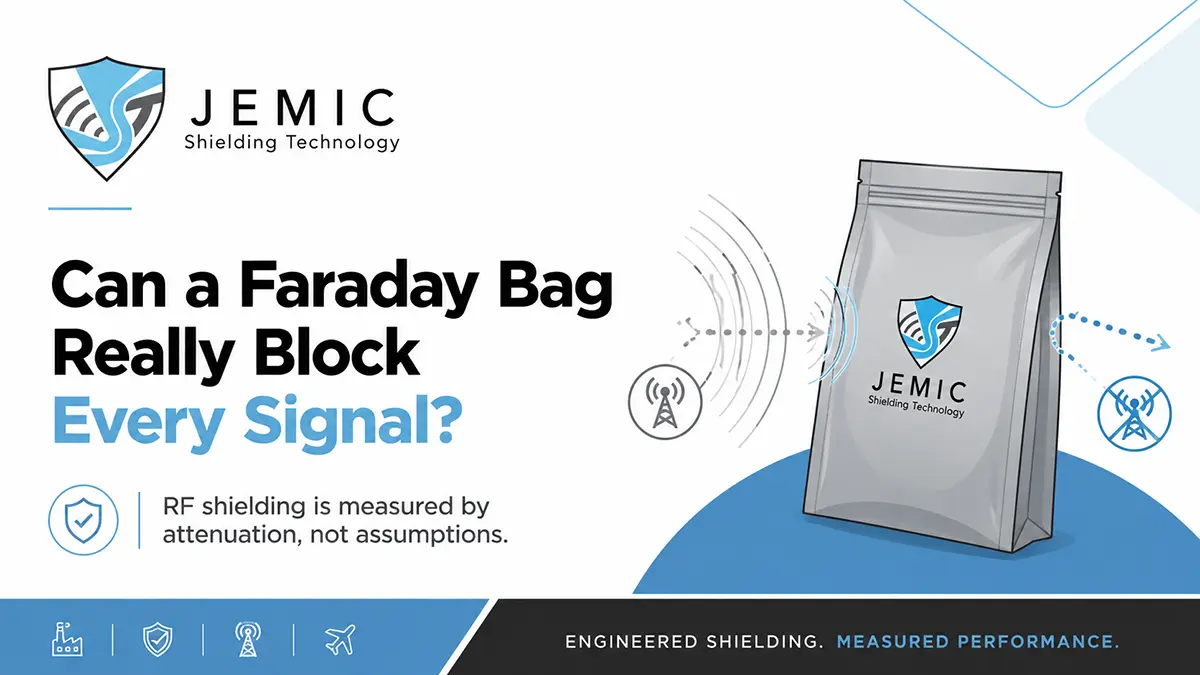
Why Your Faraday Bag Test Might Be Wrong
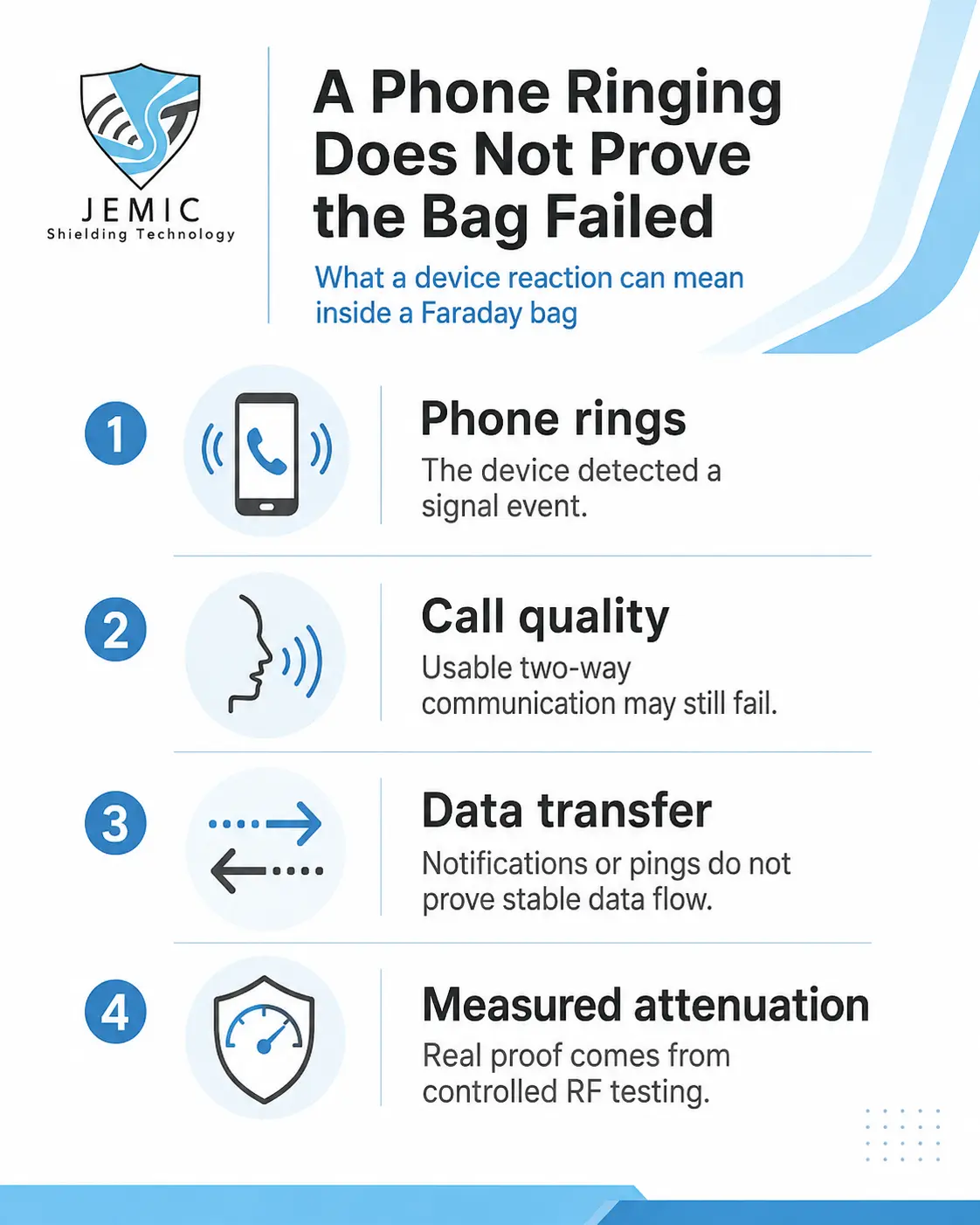
For security teams, evidence handlers, engineers, and facility managers, a Faraday bag test is not about curiosity. A protected device poses a risk if it can still communicate from inside the bag. A phone test seems simple until the phone rings inside the Faraday bag. A tracker test seems simple until the location still appears on the map. A signal check seems simple until a single bar appears on the screen. Those reactions feel like proof, but RF shielding does not work like a light switch.
The real question is not whether a Faraday bag makes every visible signal disappear. The real question is whether the closed bag provides sufficient measured attenuation across the frequencies used by the protected device to prevent useful communication. That distinction matters because phones, trackers, Wi-Fi, Bluetooth, GPS, GNSS, and 5G signals do not all behave the same way. A serious Faraday bag earns trust through measured dB loss, frequency coverage, closure integrity, and finished-product testing, not through a casual phone-call test.
A Faraday Bag Does Not “Block” Signals the Way Most People Mean It
A Faraday bag should be judged by measured signal reduction, not by whether every device looks dead. Engineers call that reduction “shielding effectiveness” or “attenuation.” ASTM D4935 defines electromagnetic shielding effectiveness as a measured value for planar materials under specified test conditions, supporting attenuation-based evaluation rather than casual yes-or-no blocking claims. That difference matters because a buyer needs a number, a frequency range, and a test condition before the claim is meaningful.
Most buyers use the word “block” because the word feels simple. A phone either rings or does not ring. A tracker either appears or disappears. A Wi-Fi network either appears or disappears from the screen. Those checks feel practical, but those checks do not measure shielding performance. The screen result only shows how one device behaves in one condition.
The better question asks how many decibels of signal loss the Faraday bag creates across the RF bands the buyer needs to isolate. A bag that reduces one signal band does not automatically prove powerful performance across:
- Cellular
- Wi-Fi
- Bluetooth
- GPS
- GNSS
- 5G
The buyer needs proof tied to the protected device, the expected signal threats, and the final closed condition of the bag. The goal is not a dead-looking screen. The goal is reduced RF energy that no longer supports useful communication.
The same phrase can mean hugely different things depending on whether the buyer is asking casually or technically.
| Common Buyer Phrase | Engineering Meaning | Better Buyer Question |
| Does the bag block signals? | The bag reduces RF energy by a measured amount. | How much attenuation does the closed bag produce? |
| Why does my phone still react? | A device event does not prove a usable link. | Did voice, data, or location communication still work? |
| Does the bag work for every device? | Performance depends on the bands each device uses. | Which frequency ranges were tested? |
| Was the material tested? | Material data does not always equal finished-bag data. | Was the closed bag tested as a finished product? |
Clear proof uses clear relationships.
- Faraday bags reduce RF signal strength.
- RF shielding uses attenuation in decibels.
- Device appearance does not prove RF isolation.
- Casual field checks create weak evidence.
- ASTM D4935 supports measured shielding effectiveness under defined test conditions.
- Controlled testing shows frequency-specific shielding performance.
 Why Decibels Matter More Than the Word “Blocking”
Decibels matter because RF shielding performance is logarithmic, not linear. A 60 dB reduction does not mean 60 percent weaker. A 60 dB reduction means a major drop in signal power. That difference explains why a buyer should ask for measured attenuation rather than a simple blocking promise. The dB value gives the buyer a concrete number to compare.
In the shop, we see this as a basic source-and-receiver example. A transmitter sends a known signal from one side of the shield. A receiver measures what gets through on the other side. If the source level and the received level differ by 60 dB, the shielding produced 60 dB of loss. That is a measured reduction, not a guess based on whether a phone looked active.
That number means more than a phone call test. A phone-call test does not show the starting signal level, receiver sensitivity, test distance, closure condition, or frequency band. A lab-style measurement gives the buyer a number tied to a band and a test setup. ASTM D4935 reinforces this point by defining a controlled method for measuring shielding effectiveness under specific conditions. That makes attenuation more useful than a pass-or-fail response from a single device.
A measured claim gives the buyer something to compare.
| Shielding Claim | What the Claim Means | Why the Buyer Should Care |
| “Blocks signals” | A broad claim with no measured value. | The buyer cannot compare performance across bands. |
| “40 dB attenuation” | A measured reduction in signal level. | The buyer receives a usable benchmark. |
| “60 dB attenuation” | A stronger measured reduction in signal level. | The buyer sees stronger shielding performance. |
| “Tested from 30 MHz to 1.5 GHz” | A defined frequency range used in ASTM D4935 material testing. | The buyer sees what the test covers and what the test misses. |
The basic measurement logic is simple when the test uses known values.
- Transmitter sends a known RF signal.
- Shielded bags reduce the signal passing through the barrier.
- Receiver measures the remaining signal.
- Difference between both readings shows attenuation in db.
- Measured dB loss gives stronger evidence than a phone-call reaction.
Relevant Frequencies Need Real Test Coverage
A Faraday bag should be tested across the bands the protected device uses. Cellular, Wi-Fi, Bluetooth, GPS, GNSS, and 5G do not all fall within a single neat frequency range. ASTM D4935 covers planar material testing from 30 MHz to 1.5 GHz, yielding useful shielding data but not addressing all modern wireless concerns. That limitation matters because modern devices often operate above that range.
That point matters for buyers in security, evidence control, law enforcement, defense, and technical environments. A device inside the bag does not use one signal path. A phone, tracker, tablet, or wireless module often uses several radios. A useful Faraday bag needs evidence across the relevant bands, not comfort from one easy test. One passed frequency range does not settle the whole question.
The buyer should care about these ranges because those ranges match common device behavior. Cellular, Wi-Fi, Bluetooth, GPS, GNSS, and 5G each pose distinct testing challenges. A bag that performs at one range still needs proof across the other ranges the protected device uses. 3GPP separates 5G user equipment requirements into Range 1 and Range 2 documents, where Range 1 covers sub-7.125 GHz operation and Range 2 covers higher 5G operation. That split supports the point that sub-6 GHz performance does not prove millimeter-wave performance.
Each signal family creates a different proof problem.
| Signal Category | Why the Frequency Range Matters | Risk of a Weak Test |
| Cellular | Phones rely on multiple network bands, not one band. | A single call test might miss other cellular behavior. |
| Wi-Fi and Bluetooth | Short-range radios use 2.4 GHz, 5 GHz, and newer 6 GHz ranges. | A lower-frequency pass does not prove higher-frequency isolation. |
| GPS and GNSS | Location receivers rely on satellite signals in the 1.2-1.6 GHz range. | A phone reaction does not prove location isolation. |
| 5G | 3GPP TS 38.101-1 and TS 38.101-2 separate lower and higher 5G ranges. | Sub-6 GHz results do not prove millimeter-wave performance. |
The relevant signal families require separate attention because a single device often uses multiple radios.
- Cellular devices use low-band, mid-band, and higher cellular ranges.
- Wi-Fi and Bluetooth use 2.4 GHz, 5 GHz, and newer 6 GHz ranges.
- GPS and GNSS receivers use signals near the 1.2 GHz to 1.6 GHz range.
- 5G Range 1 covers sub-7.125 GHz operation under 3GPP TS 38.101-1.
- 5G Range 2 covers higher 5G operation under 3GPP TS 38.101-2.
 The Closure Matters as Much as the Material
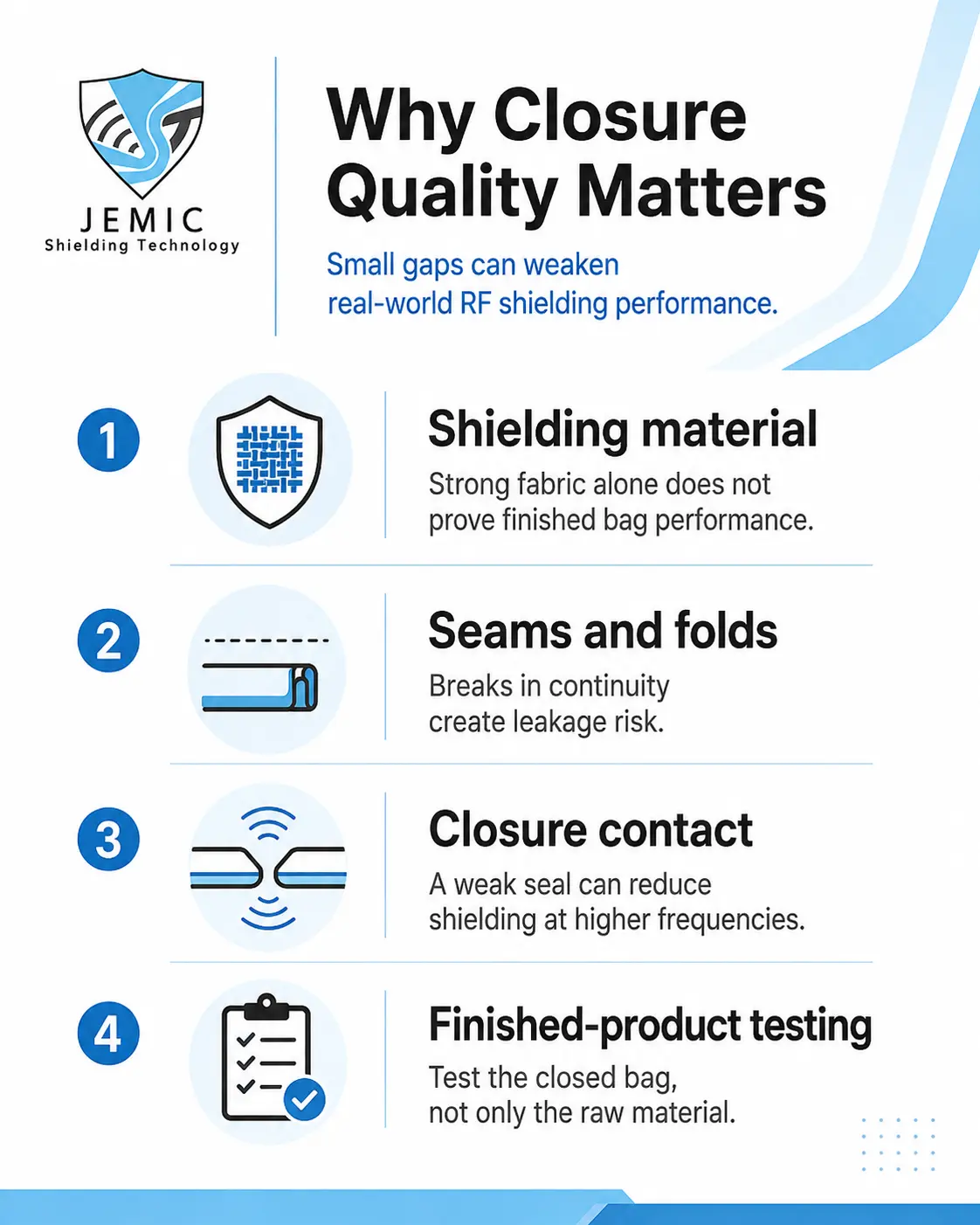
A finished Faraday bag is more than shielding fabric. A finished bag has seams, folds, corners, pressure points, and a closure. IEEE 299.1 exists because small enclosures between 0.1 m and 2 m create different shielding test problems than large, shielded rooms. That distinction supports finished-product thinking instead of fabric-only thinking.
That distinction matters because a raw material test does not prove the finished bag. A flat sample might perform well in a controlled fixture. A bag in daily use still needs to close properly, maintain contact, withstand handling, and minimize leakage through weak points. The buyer should care about finished product data because the closure becomes part of the shield. A weak closure can undermine the shielding provided by strong shielding material.
Higher frequencies make this issue more important. Small gaps become more meaningful as wavelengths shrink. A closure that seems acceptable during a low-frequency check might leak at higher Wi-Fi or 5G frequencies. That is why buyers should ask for finished-product data, not fabric-only data. The relevant product is the closed bag in use, not the material itself.
Different test targets answer different buyer questions.
| Tested Item | What the Result Shows | What the Result Does Not Prove |
| Flat shielding material | Material performance under controlled conditions. | Finished bag performance after closure. |
| Finished closed bag | Whole-product shielding behavior. | Every use condition unless repeated testing confirms consistency. |
| Large, shielded enclosure | Room-scale shielding behavior under a different test problem. | Small bag or pouch behavior. |
| Small enclosure testing | IEEE 299.1 addresses methods for determining shielding effectiveness for small enclosures. | Fabric-only performance across all final-use conditions. |
| Casual phone test | One device result in one location. | Measured attenuation across RF bands. |
The weak points are usually physical rather than theoretical.
- Seams affect shield continuity.
- Folds affect surface contact.
- Corners affect finished enclosure behavior.
- Closure pressure affects leakage control.
- Repeated handling affects consistent shielding performance.
- Finished-product testing gives stronger buyer proof than raw material testing alone.
The Real Test Is Attenuation Across the Right Frequencies
A Faraday bag should not be judged by whether every signal appears to vanish from a screen. The accurate test is measured attenuation across the frequencies the protected device uses. Phone rings, tracker pins, signal bars, and app reactions can mislead buyers because those results do not prove usable communication. A serious evaluation connects the RF band, the dB loss, the closure condition, and the finished bag.
That turns the question from a casual “does the bag block everything?” into a measurable engineering question. The honest answer is this: a Faraday bag earns trust when the closed bag reduces the right signals enough to stop useful communication.